


Choosing an integrated silicon optical sensor
Useful in a broad array of apps, silicon photodetectors offer many options for tailoring their performance to your design
BY MICHAEL WILSON
Texas Advanced Optoelectronic Solutions, Plano, TX
http://www.taosinc.com
Optical sensors, also referred to as photodetectors, are available in a variety of different substrates: germanium, indium gallium arsenide, gallium phosphide, and silicon. All have varying spectral and temporal responses and applications, but the nonsilicon based sensors have more narrowly defined application spaces, whereas silicon-based sensors suit applications from medical to industrial/commercial to consumer.
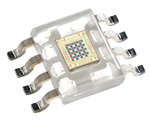
Silicon optical detectors, like the TAOS TCS230 color sensor with integrated RGB filters, offer numerous options to suit a broad range of applications.
Not only do they span a much broader scope than other photo detectors, but silicon opto sensors also lend themselves well to integration with other circuitry, which often makes them generally a more cost-effective solution. This is partly the reason why they have such a high adoption rate.
Despite their universal applicability, choosing the most appropriate silicon sensor can have a significant impact on design performance. Fortunately, there are common criteria for selecting an integrated silicon optical sensor across a large application base.
Common criteria
Within the silicon IC detector arena, there’s a lot to consider when selecting an optimum detector for a specific application. Factors include type of light conversion, conversion rate, and spectral response.
Integrated optical sensors can convert light to different types of outputs, including light to current (LTC), voltage (LTV), frequency (LTF), and digital (LTD). They can differ in how quickly they respond to light and generate a corresponding output, ranging in speed (response time) from milliseconds to a few nanoseconds.
The spectral response of silicon detectors falls within the portion of the electromagnetic spectrum from near-UV (300 nm) to near infrared (1100 nm), which includes visible light (400 to 700 nm). It should be noted that, across this range, spectral response is not uniform.
While the above three criteria are not the only factors to consider when selecting an optical sensor, they go a long way in narrowing the selection field, so that final criteria — such as cost and packaging — can be applied to similar types of devices.
Light conversion
LTV and LTC devices convert light energy into a voltage or current outputs respectively. Both devices have many of the same applications and can be used interchangeably. So in the following discussion of the LTV device, remember that the same applies for the LTC if you substitute current for voltage.
The LTV device’s output level will increase and decrease with the power of the light being sensed. The dynamic range of the device is the range between the minimum and maximum output voltage. Called the dark voltage (Vd ), the minimum voltage level/output occurs when the input light level is equal to zero. The maximum or saturation voltage level corresponds to the maximum amount of light-energy input the photodiode is capable of converting; even if the light-energy input exceeds this value, the output will be the same.
LTV/C detectors suit applications where fast changes in light intensity need to be monitored: for example, a production line where each object on a fast-moving conveyor belt must be detected as it passes a point. Typically, an A/D converter would be required to interface the sensor to a microprocessor or other type of controller.
LTF devices convert light energy into a waveform whose frequency is directly proportional to the light intensity being sensed. The dynamic range of an LTF device is set by its minimum and maximum output frequency. The minimum frequency or dark frequency is outputted when the input light intensity is zero. The maximum, or full-scale, frequency is the frequency at which there is no further increase in output frequency for an increase in light level.
With dynamic ranges much larger than LTV devices, LTFs are suited for applications that need more resolution. For instance, a linear LTV device with a 4-V dynamic range and 4 mV of noise (dark voltage) would provide 1,000 steps, while an LTF with 1-MHz dynamic range with 0.5 Hz of noise (dark frequency) would offer 2 million steps, like the TAOS TSL237. A frequency counter or microprocessor is required to process the LTF’s frequency output.
LTD devices convert light intensity to digital data. The digital data is then stored in an internal register where it will change in direct proportion to the intensity of the light falling on the sensor. The LTD device is typically interfaced to a microprocessor using one of a number of different protocols including SMbus, I2 C, and SPI to name a few.
The dynamic range of the device is the difference between the minimum and maximum register values. The digital interface also enables these devices to have a level of programmability to control such things as gain and integration time.
Most LTD devices are addressable, which means a number of devices can coexist on a single bus, minimizing interconnection costs. The TAOS TSL2563 is an example of an LTD device with programmable gain and integration time. Via it’s I2 C interface, the sensor provides an interrupt when programmed states are encountered.
Conversion rate
The speed at which the photo-detector is able to convert a change in light energy to a usable output is an important consideration in many applications. Independent of the type of output, the biasing and size of the photodiode are major factors in determining the sensor’s conversion speed: the larger the photodiode, the greater its capacitance and the slower its response to light-intensity changes. As a result, reverse biasing is used to increase conversion speed. Note that it is typically the integrated circuitry, not the photodiode, that is the limiting factor in determining the conversion rate of an integrated sensor.
Although slightly different, LTV and LTC devices can be categorized together as light-to-analog (LTA) devices. LTA devices offer fast response times relative to LTF or LTD devices because there is a minimum of additional circuitry — a current amplifier (CA) or transimpedance amplifier (TIA) — beyond the photodiode. The speed of an LTA device is measured in rise and fall times of the output and will be dictated not only by the biasing and size of the photodiode as state above, but also by the capacitance associated with the CA or TIA.
To the photodiode limitations, an LTF device adds the current-to-frequency conversion time. Typically, the conversion will be complete within one period of the frequency output to which it is changing. Therefore, an LTF device will be slower when responding to a light intensity that produces a 1-kHz waveform than one that produces a 1-MHz waveform. This can be important if very low light levels are being measured.
The speed of an LTD device is somewhat different than an LTA or LTF device because the LTD device is normally not continuously placing data on the output bus; it usually supplies data only when it’s asked to do so by a controller. Until that time, data is loaded into the data register. It is the speed of the bus that will determine the conversion rate.
Spectral response
Knowing the spectral sensing requirements of an application and matching it with a sensor that has the appropriate spectral response is an important system consideration. For example, a proximity detector application using a near-IR LED will require a sensor that will respond to spectral energy only in the near-IR region. It must not respond to light energy in the visible range. This can be accomplished either by using an external visible blocking filter or by selecting a detector that has an integrated filter.
The same type of considerations need to be made when the applications calls for sensing only in the visible region, as in colorimetry. The near IR energy of the sun or other illuminant needs to be filtered out, which is done by using an external or integrated IR blocking filter. This type of application also requires red, green, and blue (RGB) filters, which may also be external or integrated.
Optical arrays
Sometimes applications require the gathering of spatial information. This can be achieved using a number of discrete devices or integrated optical linear arrays.
Integrated optical linear arrays consist of a number photosites, or pixels, usually arranged in a single line. The center-to-center spacing of the pixels is called pixel pitch and is typically given in dots per inch (dpi).
A 400-dpi device will have a pixel pitch of 63.5 μm. The spatial resolution corresponds directly to the number of the dpi; the higher the dpi the higher the spatial resolution. For a given dpi, the number of pixels sets the active length of the device; for instance, the 400-dpi 128-pixel TAOS TSL1401 has an active length of approximately 8 mm. The output of these devices can be analog (usually voltage) or digital. The speed of these devices is determined by the integration time (the time that light is allowed to fall on the device) and the clock speed.
For most applications, linear arrays are selected by the number of pixels, the active length, the resolution, and the clock speed. Linear arrays are ideal for scanning-type applications, but also suit position and edge detection.
End game
Once choices have been narrowed based on conversion type, rate, and spectral response, the final selection can be based on other criteria, such as package type, temperature range, and, of course, cost. Typical operating temperature ranges are commercial (0° to 70˚C), industrial (–40° to 85°C), automotive (–40° to 105°C), and military (–55°˚ to 125°C).

Fig. 1. Sensor type versus level of integration
Usually, cost will scale with silicon size. As a rule, the larger the silicon device, the higher its cost. Optical applications have trended toward higher system integration (see Fig. 1 ). The higher the integration, the higher the sensor’s complexity but the lower the part counts for the application. ■
For more on optical sensors and phototdectors, visit http://www2.electronicproducts.com/Opteoelectronics.aspx
Advertisement
Learn more about Texas Advanced Optoelectronic Solutions