

Designing for this demanding market isn’t all fun and games
CONDUCTED AND MODERATED BY RALPH RAIOLA
Cell phones, microwave ovens, dvd players, and laptop computers: very different devices that, when it comes to their being produced, have similar requirements. These kinds of devices are bought and used by the general consumer, so the demands are simple: easy to use, full of functionality, and as inexpensive as possible.
These demands, then, have become the charge for any electronics supplier playing in this market. But, as you’ll read during the course of this forum, the consumer electronics industry isn’t all fun and games.
Electronic Products : Give us your thoughts about the consumer electronics industry and the role electronic components play.
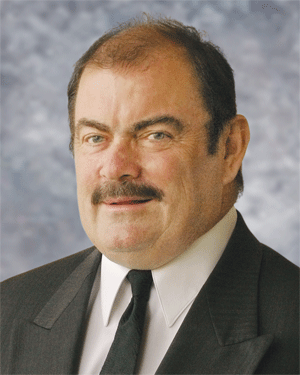
Michael Bereziuk (Chief Operating Officer, Tessera) : At the moment it’s very much an industrial-design-driven industry. Good examples are the iPod and the iPhone, where the form factor and the user interface are what most people see. The challenge for us is to miniaturize and to reduce the cost of the components that go into [those applications] so more functionality can be put into what is basically the same form factor.
The future is not really one of traditional electronics module construction, for example, single or multiple flat printed-circuit boards with single-chip ICs. We see things moving rapidly toward 3D mixed-functional structures, flexible substrates, and the casing being more of a substrate than just a traditional casing.
So no question, the two key drivers in consumer electronics are cost and miniaturization as a result of this trend. For example, the cell phone, which is a very good driver of a lot of this technology, is expanding beyond its original application. The form factor is pretty much staying the same, yet people are demanding more and more functionality there.
What drives products today is really the mobile convergence of voice/video/data with seamless mobility, and we see that continuing to accelerate. This presents the industry with two distinct challenges. We call it on-and-off chip electronics.
On-chip, the challenge is to get lower-profile, smaller-form-factor, higher-functionality silicon. And our own company has developed and released packaging technology we call µPILR which addresses those needs.
The other area is what we call off-chip electronics, which is where the need is to miniaturize and reduce the cost of the batteries, connectors, passive components, and functions like camera modules, as well as to improve the display technology and the interconnect.
And again, we have developed technology that applies to this area. What is most significant for us is the OptiML range of wafer-level camera module technology we’ve just announced, which dramatically reduces the size and cost of a camera module and makes it surface mountable in the mobile phone or appliance.
Associated with this is a move toward what we call “smart optics”, which essentially replaces traditional functions like mechanical zoom and auto focus with custom lens design with image processing that achieve basically the same results with a higher-reliability, lower-cost, and much smaller nonmechanical solution.
Barbara Wiesinger (Director of Product Development, BI Technologies) : As we’ve grown in the consumer electronics industry, certainly cost has been a driver, and what we’re finding is there’s a cost associated with a product being in what we would consider a disposal mode. One of the things we’re seeing is that many—even in our industrial base of customers who are now looking to do more in the consumer side—are talking more about a product being disposable. And then cost becomes a factor. Going back to what Mike was saying, miniaturization is very important because no one expects to have a large piece of equipment, for example, in their home or in their garage.

And the other thing we’re seeing in working with a lot of our customer base is ease of use for the consumer and then how do our products play into that. What other functionality can we put into our products so it stays in the same size that it currently is and yet offers our customers more functionality?
Electronics Products: So does that mean things like adding sensing capability?
Barbara Wiesinger: Yes, or you could do position sensing of a product that’s moving, but then you may also be looking at torque in that product so you add two sensors into one package. And then, of course, we’re looking at how inexpensively we can do that while retaining the quality of the product.
But we also see in consumer electronics—and this is something we’ve been dealing with a lot recently—that so many of our customers have very similar applications but they’re using different products for those applications. And the customer’s call to us as the component manufacturer is, can we make one product to fit a multitude of products or applications?
Because what the end-customer is looking to be able to use—with some of these joysticks for gaming equipment and things like that—is one type of product from a steering wheel to a joystick, but still have some of the same functionality they’re used to using.
And, so, the challenge has been to help our customers reduce their inventory and their number of parts. They’re looking for one part to kind of multitask across a whole range of products.
Electronic Products : Can you give me some examples of how disposability has changed?
Barbara Wiesinger: The disposable side of it tends to be where in the consumer world if they use a product for two, three, four, five years they’re not unwilling to get rid of it and replace it with something new. As far as the life and reliability of our product, we’re the same. But the disposable side is even into some large equipment like home welding equipment. They’re now looking at it as being disposable. So they’re lowering warranties in the field and their warranty level goes down to much more of a consumer level than it did for an industrial customer.
Needless to say, they’re expecting our product to last ten years even though in the field they’re really offering 90 or 120 days for the warranty. So it’s changing. But again, it’s also the industrial customers reinventing themselves into a more consumer world.
Jean-Michel Bourin (Product Director, C&K Components) : The drivers are more or less the same for the electronic switches that we provide. There are many in mobile phones, MP3 players, digital cameras, satellite radio, Bluetooth headsets—all those kind of consumer goods.

The drivers on the products are, of course, cost, size—we are down to less than 0.5-mm thickness with a footprint of 3 x 2 mm, and already working on the next generation and new functionality. We’ve gone from about 50,000 cycles a few years ago to 500,000 cycles today. People have games on their mobile phones, and an MP3 [player] is quite demanding in this way, with users moving sound up and down and [scrolling through] their playlist.
Another factor that is driving us is the short life of the end-product, which means that we need to be able to ramp upfrom zero to 100,000,000 pieces in less than one year. And then we need to be able to ramp down the same way while we develop the next generation.
If we look back 10 years ago, many of our switches are still in use today. The ones we develop today will probably be alive in 10 years but not in the same market, not with the same quantity, and not in exactly the same product.
Electronic Products : It sounds like you’re doing a lot of designing where somebody comes to you with a specific request or need?
Jean-Michel Bourin: Every three years, we develop a new switch that is half the size of the old one because the mobile-phone manufacturers come to us and say, “Okay, I want a slimmer phone and my switch on the side,” and it’s much slimmer. Investments are huge because to produce 100,000,000, you need to be fully automated. You cannot do that by hand, especially when it’s made in Europe.
And as far as functionality, we need to put more function [into a device]. As Barbara said before, we need to put a navigation device in one switch, sensing the movements on your finger, or sensing different kinds of things. And we try to do that only using electromechanical that doesn’t consume any power. Sometimes we have to use other devices. But most of the time, we try to do that through electromechanic.
One of the limits of this game of miniaturization is the assembly. We get more and more involved in the process of our customer because our switches are so small today that they fall inside the tolerances of the package of our customer. And it’s sometimes difficult to integrate and still activate them.
Jamie Mullane (Chief Operating Officer, Stackpole Electronics) : Not to be completely redundant here, but as a primarily discrete resistor manufacturer, the two main drivers are still going to be cost and miniaturization. From a discrete component standpoint for caps, resistors, inductors, we’re now down to where the 01005 size is commercially viable and available from multiple manufacturers.

In line with the last point Jean-Michel made, in a lot of cases the component technology or component downsizing is ahead of the manufacturing technology. While the 01005 is commercially viable on the resistor side from three or four different manufacturers, there are very few people out there who have the technology to place them.
Electronic Products : Has that always been the case?
Jamie Mullane: I’m thinking back to my days in Murata when we introduced the 0201, and I think it’s fair to say that it’s always been a little bit ahead. At least in the last five years or so.
Electronic Products : Where do standard RLC products fit in consumer electronics?
Jamie Mullane: Basically, caps and resistors are everywhere. I don’t know how to pare it down any further than that. Certainly filtering applications. You know, some interesting challenges as you get into power, with maybe a little bit different perspective is in the miniaturization of components.
In consumer electronics, generally power isn’t as much of a concern from the resistor standpoint. But where there are power considerations, you’re going—like everywhere else—against the laws of physics in trying to get more power handling in a smaller component.
I guess the other point is that as we get down to 0201 and even 01005, miniaturization and cost reduction at this point are working against each other. So 0402 is really the bottom of the price point in terms of size of passive components. And once you make the jump to 0201, you’re increasing about 3X and then going to 01005, you’re jumping 10X or more. That’s going to change along the product lifecycle, but it’s not going to change, I think, as quickly as it has in the past.
Seri Lee (CTO, Nextreme Thermal Solutions) : The terms that the previous speakers have used—cost reduction and miniaturization have all pretty much been a common theme for the past couple of decades, regardless of whether it’s coming from the consumer electronics or from the PC industry, which is now more or less a consumer product.

As we all know, the PC industry and the microprocessor industry has been progressing without having too much trouble and being on track with what’s been called Moore’s Law until a few years ago. Every generation, which in terms of PC industry, represents about three years, components increased by 2X, power consumption went up by 20% to 25%, and all that power that’s been shoved into smaller form factor with more functionality and higher performance becomes wasted heat.
So, power delivery and heat removal technologies were due to become the limiting factors for that particular industry and for the advancement of being on track under Moore’s law. We all know that what used to be a frequency war, a speed war, finally sort of slowed down and ended at around the low 3-GHz range.
The metric for the competition has changed from pure performance in frequency to the performance per power consumption. And as we want to put more functionality into a fixed or even a smaller form factor, power functionality does not improve that much. So, as I’ve been into this particular sector of the discipline that deals with power management of electronics, I see this is becoming more of the limiting factor for many other electronics beyond microprocessors.
For example, set-top boxes and even the TV industry have all kinds of problems with heat dissipation and high-temperature problems. Obviously, that limits functionality—not only performance and efficiency. I’ve been talking to cell-phone suppliers and the designers who say they can put in a lot more functionality if they can solve some thermal problems.
Electronic Products : Let’s talk about convergence. Is the consumer demanding all this functionality in a device or is it the end-manufacturers?
Seri Lee: Many of us, including myself, justify what we do by saying there are consumers demanding miniaturization and multiple functionality into a small form factor and so on and so forth. Is that really a fair statement that the consumer is demanding these things?
I think a fairer statement might be that we want to create these things and are actually creating consumer demand. In other words, we create something that the consumer might like and when they like it, then it becomes demand.
But for myself, I’m in the technology business, and at the same time, I am content with what I have in my cell phone. But at some point, if I have more of this; I’m going to get a headache.
Jean-Michel Bourin: It’s also the way that innovation works. Technology is just proposing new things—innovation or marketing or design is proposing new devices with convergence out to the market—and then the consumer chooses what will be a success. You have no demand if the market doesn’t know what is possible.
Barbara Wiesinger: I think that the electronic companies that are sitting over on the consumer side and are selling to consumers do a great market survey and know what consumers are asking for. I think they also try and look ahead and put some things out there to entice people, but I think they’re being driven by the consumer market telling them what they want.
But, the thing that happens many times—and I was somewhat alluding to it a little earlier—was the fact that when you’re trying to do this, you have to, as Jean-Michel said, gear up faster, quicker, better but also be able to gear down and come back and do something very quickly.
And as we’re trying to put more multitasking functionality into products that we all build, either we come up with one solution for many different or very similar applications, or we have to be ready to bring lines up and down constantly and be very efficient at it because we won’t stay in business if we’re not. It is a tough market.
And as a component manufacturer, we’re just trying to make sure our technologies stay as current as possible to keep offering our customers the most cost-effective product out there and do it better than our competitors.
Size for us is especially tough. We are not as good as switch people and we are not as good as anybody on a board level. We have some board-level products certainly, but we still are getting called on to get smaller even in existing older style packages.
Electronic Products : At some point, is there a limit to the size?
Barbara Wiesinger: From our perspective and our products—yes, there is. We can get smaller, we can do a lot of things, but we’re impacted because there is power. So you’re having heat issues. And to try and get that heat away from the component, that’s a limiting factor.
Jean-Michel Bourin: Convergence for us means integrating several functions in one switch, like navigation devices. And we go from miniature joysticks that are 3 to 4-mm high to a flat device that is less than 2-mm high.
So we go to a flat device integrating between five and nine functions in one electromechanical device. Miniaturization is, of course, a factor. But [our products] are small because of the size of the overall package. We are not inside the package.
We are not in the active electronics or in capacitors, which are touched by the convergence with the need to fit more electronics inside. We are affected by the need for better interfaces for the user.
Electronic Products : If the cell phone gets smaller, you can’t have a huge navigating device obviously, so you have to get smaller too.
Jean-Michel Bourin: We need much smaller switches, some switches that do several things. And when you go to this size, we have to go a little further than the assembly process can handle.
It’s very difficult for our customer to find assembly processes that are able to process our product. More and more, the substrate is flexible as there is no room for putting a PCB on the interface. So you use a flex substrate, and placing and soldering miniature switches on a flex becomes increasingly more difficult. We already work on that. We all believe that current assembly technology is adequate but it needs to go to the next step in the near future.
Jamie Mullane: We haven’t spoken too much about integrated passives and integrating multiple discretes into one device. For us, the focus is mostly on multiple resistors per device: resistor networks or resistor arrays.
Whether it’s having multiple resistance values on one array—which is a new product that’s being introduced—or getting multiple passives into one device, that’s what the focus is. Especially in the wireless world, where there is a lot of filtering and you’re looking at downsizing RC filters or bandpass filters.
Using thin-film technology and semiconductor processes to develop integrated passive devices for filtering is certainly a big area for wireless communications. Part of this whole convergence, as somebody mentioned before, is about wireless mobility, and people wanting that in all their devices.
Electronic Products : So convergence for many passive manufacturers may mean putting technologies together as a packaged solution as opposed to an individual component?
Jamie Mullane: Well, all of it relates to miniaturization when we’re talking about convergence and multiple functionality. And for us, still, it means downsizing the individual components to keep the form the same and increasing the functionality.
Seri Lee: The word miniaturization comes popping up. As we all know from the microprocessor industry, the progress of the technology has been based on miniaturization or reduction of length of scales, going from 130 nm to 90 nm and now there are products out there available at 45 nm.
Twenty-five-nm technologies are already under development but as the length-scale goes down to that small, what happens is that the power leaks literally through the molecules of the die. So that is ultimately limiting the performance of the device. That drove the industry to go with multicore devices without being able to increase frequency as a performance metric.
Miniaturization is actually good in terms of my discipline. Whether I have a solution or not, you know, it increases the demand on the thermal solution issues.
I view myself as a thermal engineer being in the waste management area. In fact, in the electronics world, the heat is waste. The reason why I decided to join Nextreme while I was with Intel is the fact that our technology, which is thin-film thermoelectric coolers, is a miniaturized version of the cooling device.
So, all this miniaturization is actually limiting the device and performance improvements. But at the same time, the solutions base is also being miniaturized to enable various products and electronic devices to be able to further miniaturize down to their limits.
Michael Bereziuk: I think in one sense we can say it’s the network operators, etc., who are trying to add value to reduce churn by adding functionality; it is the triple- or quad-play, if you like, that’s clearly driving multiple functions. I think the next major wave to hit will be video on mobile appliances which drive a lot of performance and power management issues.
As multiple functions go into the device, I think the issues become: how we reduce the interconnect delays. And we’re looking at the wider use of substrates instead of traditional printed-circuit-board technology.
I think the two key challenges for the industry—one of which is not being mentioned and the other which is being pretty well covered—are reliability and thermal management. With the thermal management issue, I agree with what’s been said before, bearing in mind that air—pure air—is probably the single largest volume in a cell phone and it’s not a good medium for dissipating heat. So, we see a need for a lot of activity in the industry, particularly on the material side, to address this type of issue.
The reliability issue is probably a little less obvious. As more and more functions come onto the cell phone, that drives a finer pitch on the devices. We’ve reached a 0.4-mm pitch, where the industry is struggling quite a bit to pass the drop test, which is probably the harshest test for a cell phone.
The smaller the pitch, the more difficult it is to survive that drop test. So, a lot of our development with µPilr is very much focused on how we enhance that reliability to achieve an acceptable result as the pin pitch goes down. Isolating multiple functions from each other to avoid interference issues—which is especially true when there is mixed functionality—is another challenge.
How small can we actually go? Well, as one of the previous speakers said, I think Moore’s Law is running out of steam in terms of how much silicon can be shrunk from an area perspective. You can go as small as the die size basically, and so the issue there is how you package the device. This is why we see a growing trend toward wafer-level as well as 3D technologies.
Essentially wafer-level, 3D, and package-on-package solutions are getting us to the next phase here in terms of miniaturization. That’s the silicon side of the business.
Passives are clearly a big area where there’s still a lot of work to be done—particularly in inductors, filters, and antennas—to achieve the size with mixed functionality we are looking for. The other thing we’re going to see here is, historically, we’ve lived in a planar, rectangular world from a design perspective. As new materials drive the trend toward 3D and other molding techniques, we’re going to see the form factor of the devices change.
Electronic Products : power consumption and efficiency and all those things. I mean, we’ve really talked about it a lot already but, you know, if there’s anything, you know, you want to say about it,
Jean-Michel Bourin: Power is, today, not a big concern for us because we produce only electromechanical interfaces, so they don’t consume any power. However, we are also working on some sensitive surfaces so, from time to time, one of the concerns is power consumption.
Outside of power, a big concern is software. When we offer a navigation system with nine functions—you can jog, you can press, you can navigate in many directions—then the mobile phone manufacturer, for example, needs to develop software to go with it. And the more focused we are in software, the better it is for the customer. And, for us, that’s more important than power so that our customer can just take the component and drop it in their device.
Electronic Products : But you said that you’re being asked to put more functionality in your products, so at some point, do these parts require power?
Jean-Michel Bourin: I think we will shortly come to require some power. We see already some devices with that.
We still manage to go around it with pure electromechanical devices but it’s becoming more and more complex. And I think very soon, the balance will be reached to have some of those products with power. That’s coming.
Jamie Mullane: As power and power efficiency relate to consumer electronics, maybe I’ll come at it from a little different angle and maybe a little more parochial in thinking. The market for current-sense resistors and miniaturization in current sensing presents some interesting material challenges for resistors specifically.
Electronic Products : In what way?
Jamie Mullane: Just in getting to very low ohmic values and keeping the TCR in check. Obviously, as you go to lower ohmic values, you have to use resistive materials that have higher percentages of metal. And the temperature coefficient of a metal is very, very high. That leads to problems with current-sensing resistors shifting out of tolerance over the temperature range.
But the main point being is that with increasing demand for portable electronics and battery power management, there is a proliferation of the current-sensing resistor and explosive growth.
Electronic Products : It’s an accepted technology and solution in consumer devices at this point, correct?
Jamie Mullane: Yes, definitely. And it depends somewhat on the choice of microprocessor. Sometimes, it microprocessor does not need a current-sensing resistor but usually it does.
Seri Lee: For the customers that we deal with, power efficiency is oftentimes the most important parameter that they go after, mainly because so many of the products—consumer products all the way through data centers and to rack-mounted computers—require high efficiency because of the amount of the power they require. So, the demand on the efficiency on our cooling solutions also is very, very critical.
And oftentimes customers or the product development team wants to improve or harness, sub-1 W power out of converted waste-heat energy into electricity at a sub 1% efficiency. And we wonder why this is being done? And what are you going to do with this power? And oftentimes, it’s not necessarily technically driven but politically, and there’s a marketing aspect as well.
And, in fact, I myself have found out while I was traveling in the Far East, that many countries—at the government level—subsidize development activity in anything that has to do with conversion of waste and alternative energies. One thing that surprised me was that if an entity owns the technology or an invention that has to do with power-saving and conversion, they can actually sell that as a product to other people.
Michael Bereziuk: Our view is that the thermal issues are going to remain for many years despite the different voltages on a system dropping. The performance increases, driven by wireless and video predominantly, are going to maintain a power dissipation, which is going to remain a problem.
Look at a notebook computer, for example. One of the biggest issues is the size of the thermal solution necessary to get the heat out of the notebook. When you speak with the notebook vendors, they would like to see major strides made in reducing the size of the solution to remove the heat.
There are really two key areas here, and both have been touched on. The first and most ideal, obviously, is you don’t generate the heat and power in the first place. And I think what we’re going to see in the next few years is a much more widespread use of intelligent and intuitive power-management solutions built into larger and larger chips, which will start propagating into cell phones.
But there’s a lot more opportunity for smart power-management functionality. Having said that, we’re inevitably still going to generate heat, and removing the heat efficiently from components is the other area we expect to see a lot of activity and particularly in the area of new materials to more efficiently get the heat out.
There are other areas. For example, in a cell phone, eliminating the actuator drive on the auto focus is a good method of removing a requirement for additional power. By going to alternative custom lens- and image-processing techniques, we can eliminate some of that power-hungry functionality.
Electronic Products : Do you think at some point some of this convergence will take a step back a little, or do you just think that’s a rolling train?
Michael Bereziuk : I think we’re going to see continued innovation keeping up with the convergence trend. I don’t think we’ll see it go backwards. But it’s certainly going to require new areas of development, particularly in the materials space as well.
Electronic Products : How are electronic components playing a role in wireless consumer applications?
Michael Bereziuk : I think that there are two or three areas where there are challenges. We expect multi-band antennas to evolve further and the question is how to make them small enough to fit into the even smaller form factors today.
Also, every radio module is different and positioning modules next to each other and/or with other components is as big an issue as the traces. So, a lot of it comes down to isolation and interference prevention—particularly true, by the way, when you go to into the 3D.
The other issue here which is going to become equally interesting in the future is this: as we get used to having multiple wireless connections with different services being provided on different networks, how will the phone or mobile appliance handle two separate network protocols when trying to decide which services to support. This is going to be as much a software issue and a “how the modules work together” issue, as much as just fitting more and more modules into the form factor.
Electronic Products : What is the role of electronics for interfacing with consumer devices?
Michael Bereziuk : I think what we see there is a wider use of sensors, both in proximity and orientation. They will definitely become more widespread, and particularly on appliances that are not connected to you.
So, as you walk up to your fridge or whatever, it might sense you coming up and give you a clear indication on what healthy foods you should choose.
The other issue which is quite interesting is the wireless connectivity. For example, one of the problems today with cell phones is the display size. We have the technology to receive and view video on a cell phone, but the display tends to be the limitation in terms of resolution quality.
With the more advanced wireless features coming in the future, you could still use your cell phone as a means of accessing the information, but view it on a separate display. So I see wireless connectivity as being a key element, as well as the user interface.
Advertisement